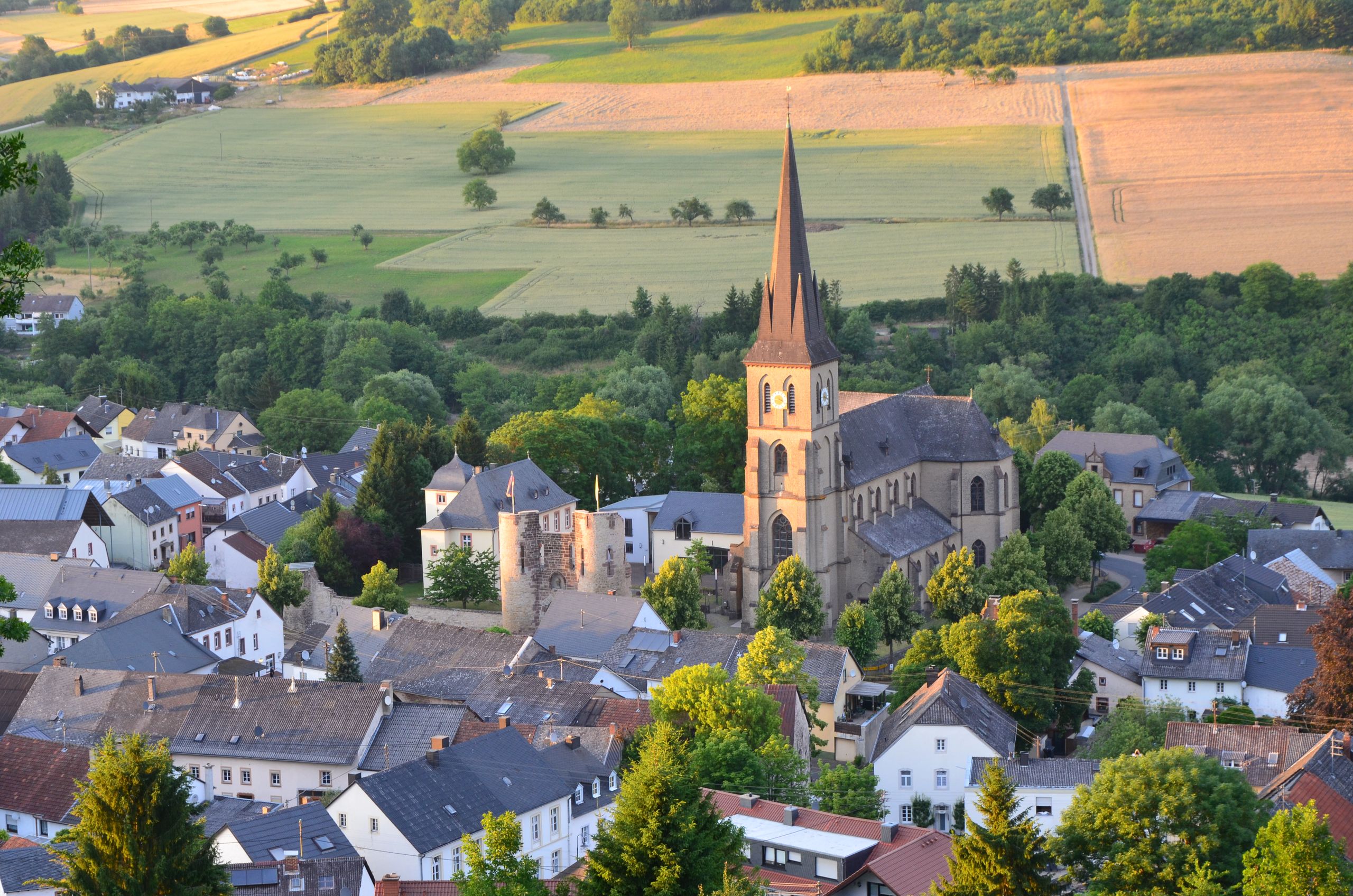
Copyright: Deutsch-Luxemburgische Tourist Information
Welschbillig
Die Ortsgemeinde Welschbillig besteht aus den Ortsteilen Träg, Hofweiler, Möhn, Ittel und Welschbillig
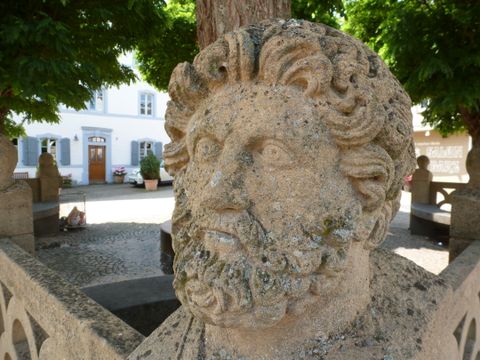
Welschbillig is renowned far beyond the region for its rich Roman and medieval heritage. During the Roman era, the emperors residing in Trier chose Welschbillig as their summer residence. Within the grounds of a former Roman villa, they created an ornamental and boating pond surrounded by 112 herms (stone pillars topped with sculpted heads).
Most of these herm heads have been recovered and are now on display at the Rheinisches Landesmuseum Trier. Discovered during the construction of the present-day parish church, this remarkable complex is considered unique north of the Alps.
In the 12th century, the Archbishops-Electors of Trier built a moated castle on the site, featuring four large corner towers and a moat between 10 and 20 metres wide. Following the castle's destruction around 1673, only the remains of the north-west tower and the gatehouse with its two round towers and stone bridge across the moat have survived. Parts of the original 1.5-kilometre town wall are still visible today.
The castle grounds are now home to the parish church and the former administrative building, creating a unique and picturesque setting for both civil and church wedding ceremonies.
In 1291, Emperor Rudolf I of Habsburg granted Welschbillig town privileges. For centuries, the town served as the administrative and commercial centre for the surrounding villages. Today, Welschbillig continues to fulfil this role with its small shopping centre and local services. It is also home to the architecturally acclaimed Kultur- und Marktscheune (Culture and Market Barn), a popular regional venue for cultural events, markets and community gatherings.
Sights
10 results
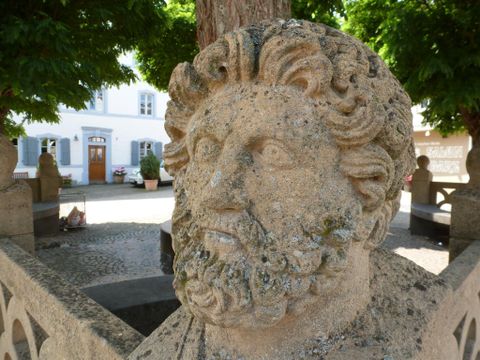
Castle & hermen complex
WelschbilligOpen today
Already in the middle of the second century, the Romans had a villa in Welschbillig. In the second half of the fourth century, they constructed an even larger one, which in U-shape was connected west of a 60-by-20-meter pond, surrounded by 112 herds.

Distillery Bohrshof
WelschbilligOpen today
We are pleased to offer you a wide range of top brandies.Enjoy your favorite schnapps in the idyll of the Eifel.
Ferienwohnung Am Nussbach
Welschbillig
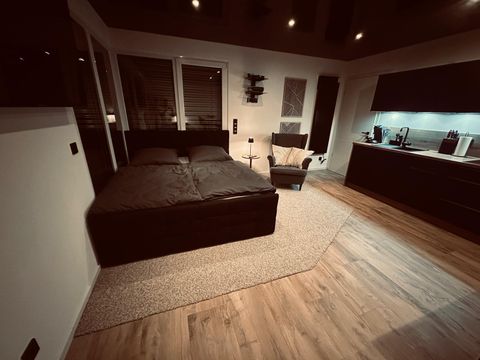
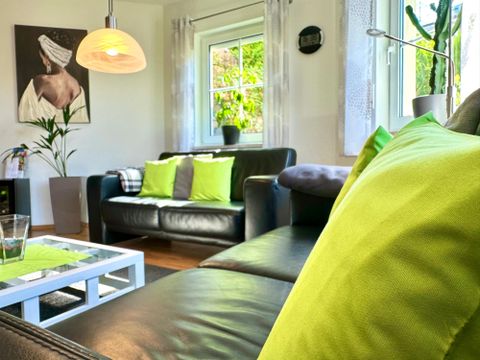
We are renting out our high-quality, 68 m² vacation apartment on the Nussbach River in Welschbillig. The newly renovated and modernly furnished apartment features a living room (flat-screen TV with DAB and FM radio, CD player, and Bluetooth connectivity) with a dining area, a separate kitchen, 1 bedroom, a bathroom, a hallway, a storage room, and a covered terrace with a panoramic view of the countryside. To ensure a stress-free arrival, the beds are already made. You’ll also find cozy towels, bathrobes, slippers, and toiletries waiting for you in the bathroom. Well-maintained hiking and biking trails are located in the immediate vicinity, such as the Eifelsteig, Mosel Bike Path, and Kyll Valley Bike Path—or enjoy a leg of the St. James’ Way. Thanks to the apartment’s close proximity to Germany’s oldest city, Trier, and to neighboring Luxembourg, you can take numerous day trips (including by public bus). To enjoy your evenings on vacation, feel free to relax on the terrace with a glass of fine wine while you dine. We offer wines from various local wineries at cost. In the interest of the majority of our guests, smoking and bringing pets into the apartment are not permitted. We ask for your understanding in this matter. Please take your smoking breaks on the beautiful, spacious terrace, where ashtrays are provided. If you have any further questions, please feel free to contact us at the email address provided. For availability and reservations, please email ferienwohnung@zengerling.com
Schiltzhof
WelschbilligOpen today
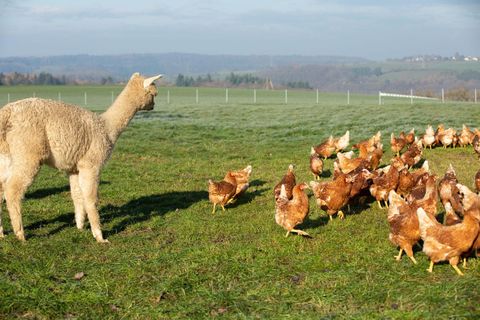
3 motorhome parking spaces, boules court, barbecue area - wood can be purchased , various seating and relaxation options in the garden, fruit trees may be harvested
Hiking
Hiking Trail Welschbillig-Möhn 11
Welschbillig-MöhnDistance:10.6 km
Duration:3:00 h
Difficulty:Medium
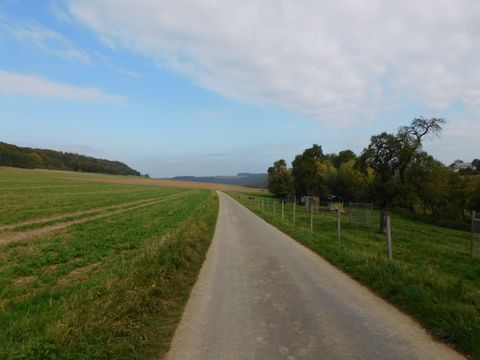
The tour begins and returns at the parish church St-Luzia of the 16th century . Through the town, along typical Eifel-houses, the route leads over the famous ``Jakobsweg`` to Messenberg. Whilst ascending, the view of the historic town of Welschbillig and Möhn can be seen. During the trail the "Jakobshut" offers shelter and resting possibilities. After the village of Träg, the path runs through a remote and romantic forest. Once the forest divides, glimpses of other villages can be seen. On the way back to the starting point, you will walk past contemporary witnesses from the past such as the Roman Langmauer.
Hiking
Hiking trail Welschbillig 13
WelschbilligDistance:7.7 km
Duration:1:45 h
Difficulty:Medium
Before the tour begins, the ruins of a moated castle, the "church", the "deanery", the "Hermenbrunnen" and the "Hermenköpfe", offer a magnificent insight into the eventful past of this village. Through one of the two former "city gates" the trail leads over a moat towards "Schilzenburg". From a distance you can spot the former monastery "Helenenberg". Worth a visit is the baroque church. Before entering a quieter part of the forest, the path now leads along a main road for approx. 200 m Another highlight is the "Geiderkreuz". The idyllic place invites you to linger. Cross the "Kreuzweg" at the "Schankstor" (former city gate) and head back to the starting point.
Hiking
Hiking Trail Welschbilllig-Hofweiler 9
Welschbillig-HofweilerDistance:5.9 km
Duration:2:00 h
Difficulty:Easy
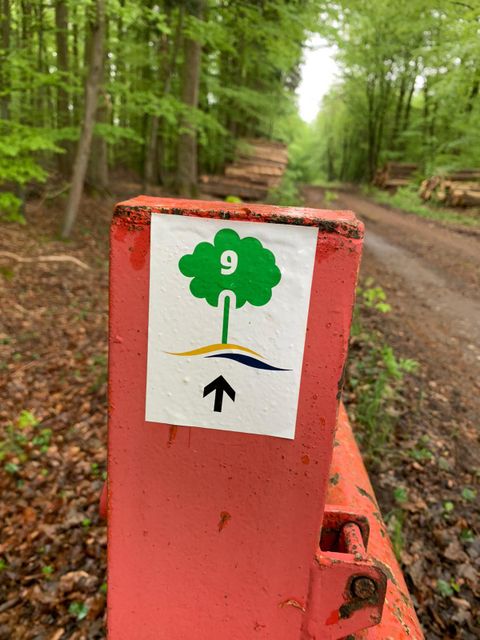
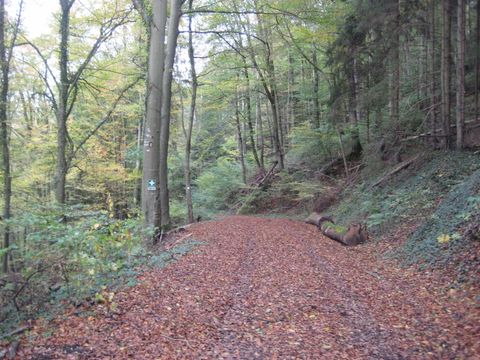
Start is at the church in Hofweiler. The small but charming village radiates a cozy atmosphere. There are great views right up to Zemmer and its districts. From the viewpoint "Kuhberg" the trail runs through the dense forest. Passing a thick oak tree, the route leads on natural paths. The highlight of the tour is the Altricher cave. The former stone quarry also served as protection in difficult times. Walk through the forest back to the village center. After a small climb, you will be rewarded with fantastic all-round views of the Eifel.
Hiking
Hiking Trail Welschbillig-Ittel 10
WelschbilligDistance:11.2 km
Duration:4:00 h
Difficulty:Medium
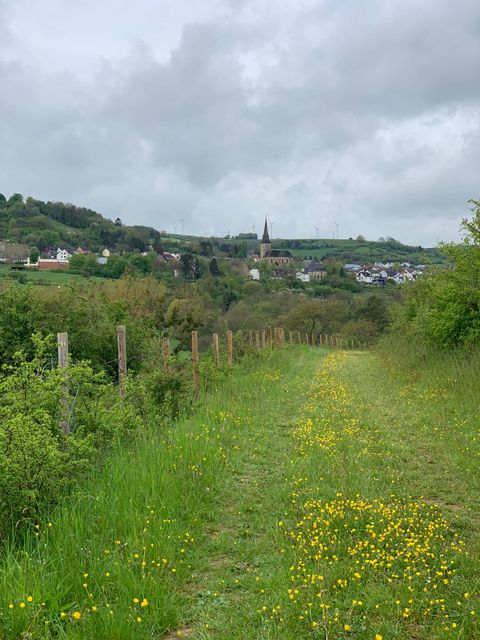
From the start, you will be guided through the village, along typical Eifel houses, farms and numerous wells. Past former quarries the way slowly leads downhill towards the river Kyll. Along the river the path runs through the village "Kyll". After a short walk along the road Kreisstrasse 17, the path then turns into the forest. The path leads along the Kyll through the forest, past weekend houses and other former quarries. Be careful again while crossing the road K16. Before returning to the starting point, the great panoramic view invites you to linger (views up to the Hochwald). You can see the foothills of Bitburger jutland with its fertile soil and orchards, ideal for fruit and excellent schnapps. From the viewpoint the way returns to the starting point.
Hiking
Wanderweg Welschbillig-Schilzenburg „Eine Spur echter“ Nr. 12
WelschbilligDistance:5.5 km
Duration:2:00 h
Difficulty:Easy
The easy hiking tour leads to a panoramic view at the top of the Schilzenburg as the highlight.